close
Choose Your Site
Global
Social Media
Views: 0 Author: Site Editor Publish Time: 2026-10-01 Origin: Site
Scaling up a production line forces plant managers into a tough corner. You have to choose the exact right granule packaging machine to hit daily output targets. Speed, however, means nothing if your weight consistency is all over the place. In today's tight-margin packaging sector, cycle speed is only half the battle. True efficiency comes down to how accurately that equipment performs during a grueling, three-shift run.
Making the wrong equipment choice leads to quiet, daily financial losses. If a machine lacks precision, facilities face "product giveaway". This is a scenario where operators intentionally deposit more product into each bag than the label dictates just to avoid regulatory fines. Over time, this subtle overfilling severely erodes profit margins. Selecting an overly complex, highly sensitive machine for a basic, low-margin commodity can be just as damaging. It often results in excessive downtime and unjustifiable maintenance costs.
Recent industry data highlights a massive shift in the global packaging landscape. Raw agricultural and chemical material costs are highly volatile right now. At the same time, regulatory bodies are strictly enforcing net-weight labeling laws. Because of this pressure, manufacturers are aggressively auditing their portioning methods. The overarching trend is a heavy migration toward data-driven, Industry 4.0 automation. Plant managers want smart weighing systems to combat profit leakage and meet strict ESG sustainability goals by reducing material waste. Traditional mechanical volume methods still hold massive market share in bulk commodity sectors, primarily due to their rugged, simple reliability.
To navigate this transition, you need a clear breakdown of the two industry heavyweights for handling granular materials. We need to look closely at the multihead weigher and the volumetric cup filler. This technical breakdown dissects their mechanical principles, factory-floor realities, and long-term return on investment to help you make the smartest bottom-line decision.
Multihead weighers measure products by exact mass. They offer exceptional precision and virtually eliminate product giveaway. They are the standard choice for high-value or irregularly shaped granules like artisan nuts, sticky candies, and premium snacks.
Volumetric cup fillers measure products by spatial volume. They provide a highly cost-effective, high-speed solution for perfectly uniform, free-flowing granules such as refined sugar, rice, and table salt.
Both filling systems integrate seamlessly with automated bagging equipment. The optimal choice depends heavily on your initial capital, product consistency, and required tolerance margins.
While volumetric fillers boast a significantly lower initial purchase price, multihead weighers typically deliver a superior long-term ROI by preventing expensive raw material waste over years of operation.
Before putting these systems head-to-head, we need to establish exactly how each machine functions under real factory conditions. Both technologies portion bulk items into individual packages. Their underlying engineering philosophies, however, are entirely distinct.
A multihead weigher is a highly advanced, computer-controlled dispensing system. From an engineering standpoint, it relies on a central distribution top cone that feeds product outward. The material moves into a network of vibrating radial linear feeder pans. These pans gently shuffle the product into a series of intermediate feed hoppers. The intermediate hoppers then drop the material into weigh hoppers equipped with hyper-sensitive electronic load cells.
The brilliance of this machine lies in its combinational logic. The central microprocessor instantly reads the exact weight of the product resting in each individual weigh hopper. In a fraction of a second, the PLC calculates thousands of possible weight combinations. It finds the exact grouping of hoppers that perfectly matches your target weight. Once identified, only those specific hoppers open to discharge the payload. Its core strength is absolute reliance on physical mass. This ensures pinpoint accuracy whether you are weighing dense almonds or airy puffed snacks.
A volumetric cup filler operates on a much simpler, purely mechanical principle. Instead of weighing the product, it measures a predetermined three-dimensional space. The machine features a rotating circular plate equipped with multiple telescopic, cylindrical cups.
As the plate rotates beneath a bulk supply hopper, gravity continuously feeds the granular product into the empty cups passing below. A stationary leveling blade then scrapes across the top of the cups. This ensures the material is perfectly flush with the brim. Once the filled cup rotates over a designated discharge chute, a trapdoor opens. The measured volume drops right into the waiting package. Operators can manually adjust the internal volume of the cups by changing their telescoping depth. The main appeal of this system is mechanical simplicity. It maintains continuous, blistering speeds without waiting for computer calculations.
When evaluating these two technologies, buyers must analyze how operating physics affect daily production metrics. Let us look at how they handle real-world stresses on the line.
Feature | Multihead Weigher | Volumetric Cup Filler |
|---|---|---|
Measurement Principle | Actual Mass and Weight | Spatial Volume |
Accuracy Margin | ±0.1g to 1.5g | ±1% to 5% of target |
Best Suited For | Snacks, irregular shapes, high-value goods | Sugar, salt, rice, uniform grains |
Speed Capacity | 60 to 120+ bags/min | 80 to 120+ bags/min |
Maintenance Needs | Requires electromechanical training | Basic mechanical skills |
The most critical operational difference lies in how each machine handles variations in product density. Granular products are rarely perfectly uniform from batch to batch. Humidity, temperature fluctuations during roasting, and minor manufacturing inconsistencies alter the bulk density of your product.
If a batch of roasted coffee beans is slightly more aerated and less dense than usual, a volumetric cup filler still fills the exact same physical space. Because those beans are lighter, the final bag weighs less than the target. This risks compliance failures. To compensate, operators must intentionally overfill the cups. A multihead weigher is entirely immune to these density shifts. It measures raw mass. A 500g target will always be exactly 500g. The machine adapts automatically to the lighter beans by simply selecting a combination of hoppers that holds more physical volume.
Error margins directly dictate your profitability. Because weighing systems utilize precise load cells and advanced combinational algorithms, their error margins are incredibly narrow. Standard 10-head or 14-head configurations typically achieve an accuracy variance of just 0.1g to 1.5g per package, depending on the individual piece weight of the product.
Volumetric fillers rely entirely on the natural flow and packing behavior of the granule. They operate with a wider margin of error. Industry averages show that volumetric filling variances typically range from 1% to 5% of the total target weight. If the product is perfectly consistent, accuracy improves. It rarely matches the fractional-gram precision of a dedicated load cell.
Historically, volumetric cup fillers were considered the champions of speed due to their continuous rotary motion. A standard volumetric filler easily exceeds 80 to 120 cycles per minute for free-flowing items. It produces a rhythmic, uninterrupted clatter of product cascading into identical pouches.
Modern weighing technology has aggressively closed this speed gap. Utilizing high-speed stepper motors and upgraded processing chips, a standard 14-head weigher comfortably achieves 70 to 120 weighments per minute. Larger 20-head or 24-head models can even exceed 200 cycles per minute. You get volumetric speeds while maintaining strict pinpoint accuracy.
Investing in premium weighing technology requires a clear understanding of its operational benefits alongside its facility demands. These machines represent the upper echelon of packaging automation.
Pinpoint Accuracy: The biggest benefit is the drastic reduction of material waste. By hitting the target weight precisely, manufacturers stop giving away free product. This compounds into massive financial savings over a fiscal year.
Unmatched Versatility: These machines excel at handling mixed products and irregular shapes. If you are packing a complex artisan trail mix, a multihead weigher can dedicate specific heads to specific ingredients. You guarantee the perfect ratio of heavy chocolate chunks to light dried cranberries in every single bag.
Data Tracking: Equipped with smart HMI touchscreens, these weighers offer real-time production monitoring. Facility managers track yield, reject rates, and average weights. You can seamlessly integrate this data into factory ERP systems for quality assurance.
Higher Initial Investment: The inclusion of multiple precision load cells, stepper motors, and complex microprocessors means these machines carry a significantly higher upfront capital cost.
Maintenance Complexity: Electronic components require specialized, delicate care. If a load cell fails or the combinational software requires deep calibration, standard machine operators usually cannot fix it. It requires a trained electromechanical technician.
Vertical Footprint: Weighers are tall structures. They require significant vertical clearance on the production floor. Facilities often need to build custom support mezzanines above the bagging equipment.
Despite the rapid technological advancements in smart weighing, the volumetric cup filler remains an absolute staple in packaging facilities worldwide. Its enduring popularity is deeply tied to its rugged, straightforward engineering.
Highly Cost-Effective: Volumetric fillers offer a remarkably low barrier to entry. Their affordable initial purchase price makes them highly attractive for startup businesses, regional agricultural co-ops, or facilities operating on strict capital expenditure budgets.
Simple Operation and Maintenance: The purely mechanical design means there are virtually no complex electronic parts or delicate sensors to break down. Basic line operators can easily manage, strip down, clean, and adjust the machine with standard hand tools.
Blistering Speed for Uniform Products: When tasked with handling perfectly uniform, free-flowing granules like refined sugar, raw rice, or agricultural seeds, these machines deliver outstanding, reliable high-speed output with minimal jamming.
Mandatory Product Giveaway: Because physical volume does not guarantee exact weight, operators must set the cup volume slightly higher than the target. This accounts for density shifts and ensures legal minimum weight compliance. This inevitable overfilling leads to consistently wasted product.
Inflexible with Irregular Shapes: Volumetric cups simply cannot accurately measure items with varying densities or chunky geometries. Large items like frozen broccoli florets or irregularly shaped potato chips create unpredictable empty air voids inside the measuring cup. This severely ruins weight consistency.
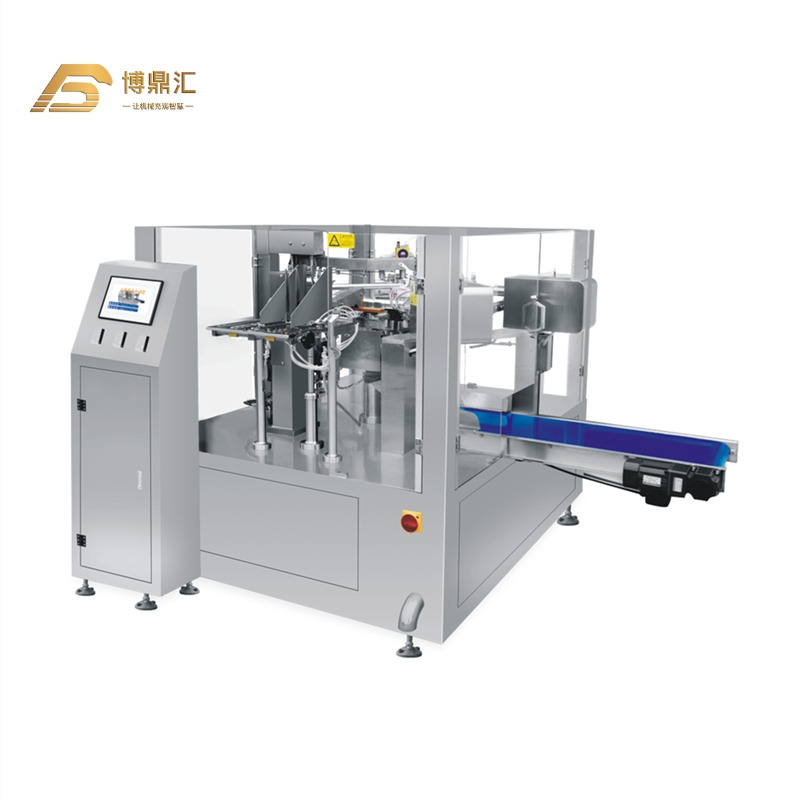
The filling system is only one half of the packaging equation. The perfectly measured product must be efficiently transferred into the final consumer container. Both weighing and volumetric systems are frequently paired with automated bagging equipment to create a seamless, hands-free production line.
When integrated, a multihead weigher is typically installed on a platform directly above the pouch packer. The two machines communicate via a central Programmable Logic Controller. As the bagging machine opens an empty pouch, it sends a "ready" electronic signal to the weigher above.
The weigher instantly drops the exact calculated mass through a timing hopper and down into the funnel of a premade pouch packing machine. This strict signal handshake is the gold standard for premium snack brands. A typical setup handles bag widths from 70mm to 200mm at speeds of 30 to 60 bags per minute, ensuring product presentation and exact weight compliance.
Integrating a volumetric cup filler relies on straightforward mechanical synchronization. The cup filler is mounted above or directly adjacent to the bagging station. As the pouch machine indexes an open bag under the discharge chute, a proximity sensor triggers the volumetric plate to rotate. It drops a single cup's payload instantly.
This combination represents the ultimate budget-friendly setup for packaging staple foods. Facilities processing hundreds of thousands of bags of rice, dried beans, or detergent powder utilize this pairing to achieve massive daily output volumes. High-speed throughput is prioritized over fractional-gram precision.
For procurement teams, the decision comes down to justifying the capital expenditure to the finance department. Choosing between these machines requires looking far beyond the initial invoice. You must analyze the Total Cost of Ownership over a five-to-ten-year lifecycle.
A standard volumetric cup filler costs a fraction of the price of a sophisticated multihead weigher. For a facility with a strict budget, the volumetric filler allows production to commence immediately without a heavy financial burden. Initial equipment costs are fixed, one-time expenses. Material costs are recurring, daily expenses that compound rapidly.
Product giveaway is the silent profit killer in manufacturing. Let us look at the raw mathematics of overfilling. Suppose a facility packages premium specialty coffee beans valued at $15 per kilogram. To ensure no 500g bag falls below the legal limit, the volumetric cup filler is set to average 503g per bag. This results in 3 grams of giveaway per pouch.
If the facility produces 20,000 bags per week, they are giving away 60,000 grams of free coffee weekly. Over a 50-week production year, that equals 3,000 kg of wasted product. At $15 per kg, the facility loses $45,000 annually to giveaway. By upgrading to a precise weighing system with a 0.5g variance, this giveaway is virtually eliminated. In this scenario, the more expensive machine easily pays for itself in less than a year through raw material savings alone.
To simplify the procurement process, evaluate your specific product characteristics and business models against the capabilities of each machine. Use the following engineering guidelines to narrow down your selection.
You should heavily consider a smart weighing system if your production meets the following criteria:
High-Value Commodities: You pack expensive items like specialty coffee, legal cannabis, premium nuts, or freeze-dried fruits where every single gram impacts your bottom line.
Irregular Geometries: Your product consists of varying sizes and shapes, such as gummy candies, pet food kibble, or mixed frozen vegetables.
Strict Compliance & Traceability: Your facility operates under stringent weight compliance regulations and requires digital data logging for audits.
You should opt for a volumetric cup filling system if your operations align with these parameters:
Low-Cost, High-Volume Staples: You pack inexpensive bulk commodities like table salt, refined sugar, raw rice, or granular fertilizer where high throughput is the primary goal.
Perfect Uniformity: Your granules are highly consistent in size, shape, and bulk density. This allows for highly predictable spatial measurement.
Limited Maintenance Infrastructure: Your facility lacks the specialized technical staff required to maintain sensitive electronic load cells.
Regardless of which technology you select, proper operation, environmental control, and routine maintenance are required to achieve the stated accuracy. Even the most advanced equipment will fail if poorly managed on the floor.
Neither machine can function accurately if it is starved of product or flooded with too much material at once. Consistent product flow is absolutely mandatory. Plant engineers strongly recommend utilizing automated Z-type bucket elevators and vibratory feeders to supply the packaging machines.
For weighers, the top cone must maintain a consistent level of product to ensure the radial feeder pans distribute the granules evenly. If the infeed fluctuates wildly, the computer struggles to find accurate weight combinations. This leads to sluggish production speeds and rejected bags.
Preventative maintenance directly correlates to filling precision. For weighing equipment, operators must perform daily "zero-point" calibrations. Dust buildup from products like spices or powders tricks the load cells into reading incorrect tare weights. The hoppers must be removed, washed, and thoroughly dried regularly. For sticky products like gummies, investing in dimpled, Teflon-coated contact surfaces is crucial to prevent product bridging.
For volumetric cup fillers, operators must constantly monitor the leveling blade and the interior of the cups. Sticky residues or trapped granules alter the physical volume of the cup. They can also prevent the discharge trapdoor from closing completely. Routine mechanical lubrication of the rotary drive ensures smooth, vibration-free operation.
The battle between these two packaging titans comes down to Precision versus Simplicity. If you handle expensive, irregularly shaped granules where material waste eats directly into your profits, the multihead weigher is the clear choice. If you move massive volumes of cheap, perfectly uniform granules and require a rugged, budget-friendly solution, the volumetric cup filler remains an excellent option.
Evaluate your initial capital, long-term material costs, and facility capabilities carefully. We encourage production managers to consult with packaging engineering specialists to run a customized ROI analysis and product test. To explore high-performance automation solutions and find the exact equipment match for your bagging line, visit SHBodinghui and connect with our technical team today.
Generally, no. Sticky or moist products tend to clump together. This drastically changes the bulk density and creates unpredictable empty air pockets inside the volumetric cup, ruining volume accuracy. Multihead weighers equipped with specialized dimpled surfaces and stronger vibratory drives are much better suited for handling sticky items.
A multihead weigher typically achieves an incredibly tight variance of just 0.1g to 1.5g per package, depending on the individual piece weight. A volumetric filler usually sees a 2% to 5% volume variance. For a 500g bag, a volumetric filler might overfill by 10g to 25g, whereas a multihead weigher will consistently hit within a fraction of a single gram.
Volumetric fillers have very low maintenance costs because they rely on basic mechanical parts like gears, belts, and bearings. Most repairs can be done in-house by standard maintenance staff. Weighing systems have higher maintenance costs. They utilize sensitive electronic load cells, stepper motors, and PLCs that may require specialized technicians or OEM support for calibration and repair.
Yes. If you already own automated bagging equipment, the filling system mounted above it is generally modular. As your business scales and your budget increases, you can remove the volumetric filler and integrate a precision multihead weigher with your existing pouch packing machine.
No, it is not recommended. Volumetric fillers cannot control the ratio of different ingredients. If you put a premixed batch of trail mix into the bulk hopper, the heavier items will settle to the bottom due to vibration. This results in bags that are entirely peanuts and other bags that are entirely raisins. A multihead weigher can dedicate specific weighing heads to specific ingredients to guarantee the perfect mix in every bag.
Both machines are capable of extremely high speeds. Because raw rice is a perfectly uniform, free-flowing commodity, a volumetric cup filler achieves incredibly high speeds, often exceeding 100 to 120 bags per minute. It does this at a fraction of the equipment cost, making it the globally preferred choice for staple grains.