close
Choose Your Site
Global
Social Media
Views: 0 Author: Site Editor Publish Time: 2026-10-19 Origin: Site
You are standing on a bustling production floor. Thousands of heavy-duty soap bottles rush down the conveyor. Suddenly, a wave of suds overflows from the bottle necks. The foam coats your machinery. It ruins freshly applied labels. Are spills and inaccurate fills bottlenecking your daily output? Surfactant-heavy liquids constantly challenge standard packaging setups. They cause wasted product, extended sanitation shifts, and severe revenue leaks. Facility managers must implement specific nozzle architectures and dynamic speed controls to overcome these daily hurdles.
This guide breaks down the exact mechanics behind fluid aeration. We will explore how to select the precise equipment required to keep your packaging line running at peak efficiency.
To engineer a reliable packaging line, you must first understand the fluid dynamics causing suds to form. Foam is simply a dispersion of gas trapped within a liquid. During the dispensing process, three primary physics principles trigger this aeration. These are surface tension, liquid impact velocity, and the presence of surfactants.
When liquid blasts through a standard overhead nozzle at high pressure and strikes the hard bottom of an empty container, kinetic energy instantly traps air bubbles. High surfactant levels in products like soaps, syrups, and industrial chemical cleaners stabilize these bubbles. This creates a persistent foam head that refuses to settle.
Failing to address this aeration at the engineering level creates compounding inefficiencies. Modern packaging lines rely on photoelectric or capacitive sensors to verify fill levels. Excessive foam triggers these sensors prematurely. The machine stops dispensing too early, resulting in under-filled bottles that fail quality control.
Spilled suds also coat the bottle exterior. This wastes expensive product and destroys label adhesion downstream. Over time, acidic or alkaline chemical spills severely degrade conveyor components. You are eventually forced to halt the entire line for manual cleaning. Slowing down the machine or adding long dwell times before the capping station is a common but flawed makeshift solution. Waiting for bubbles to pop drastically reduces your bottles-per-minute output. It directly damages your facility return on investment.
Looking at recent shifts in the global packaging sector, there is a massive push toward intelligent fluid dynamic automation. Market demands require higher throughput with zero product waste. Consequently, modern facilities are rapidly abandoning static-speed pneumatic machines. They are transitioning to AI-assisted, servo-driven platforms.
Current industry data highlights a growing necessity for continuous motion tracking technology. Instead of stopping bottles to fill them, advanced systems move the nozzles alongside the containers. This eliminates the kinetic shock of sudden stops and starts. By synchronizing the nozzle array with conveyor speeds, manufacturers maintain perfectly stable fluid surfaces. This technological leap allows facilities to process highly aerated liquids at unprecedented speeds while cutting product waste by up to thirty percent. Investing in a modern liquid filling machine equipped with these smart tracking features is now the baseline for competitive manufacturing.
The dispensing tip is the most critical point of contact in any fluid packaging system. Standard top-fill nozzles drop the fluid through the open air. For suds-prone products, this free-fall is the absolute primary catalyst for aeration. Upgrading to an anti-foaming filling nozzle alters how the liquid enters the container. It prioritizes gentle displacement over forceful injection.
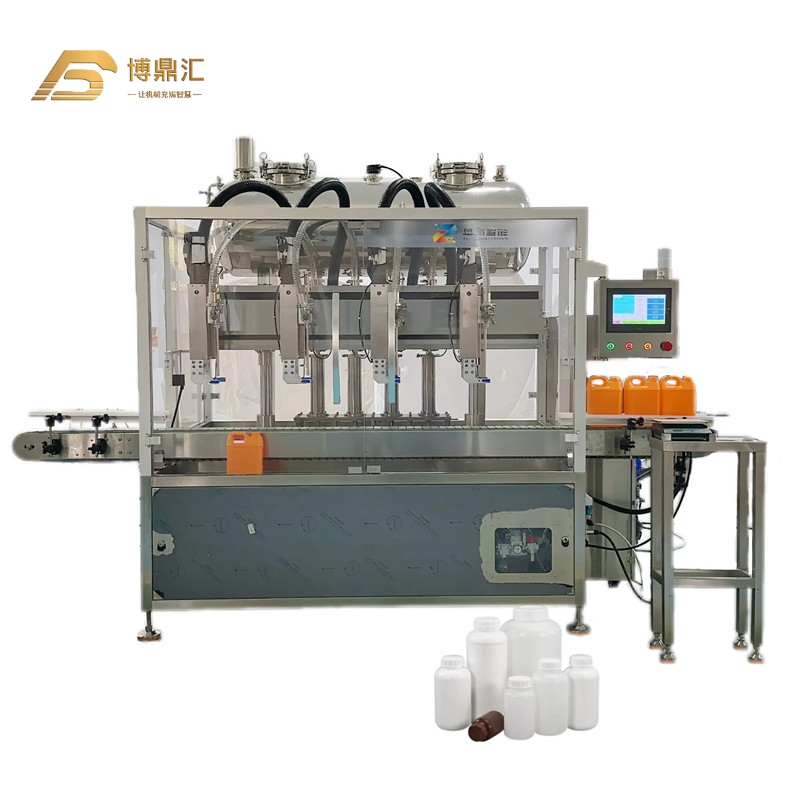
The engineering gold standard for preventing aeration is the bottom-up filling method. This is achieved using precision diving nozzles. Mechanically, the system utilizes pneumatic cylinders or high-torque servo motors to lower the nozzle array directly into the empty containers. Dispensing only begins when the tip is mere millimeters from the bottom.
As the liquid level rises, the nozzle retracts upward in precise tandem. The dispensing tip remains completely submerged beneath the fluid surface at all times. Keeping the injection point submerged entirely eliminates the liquid free-fall impact. The fluid displaces the air from the bottom up. Pairing a servo-driven diving nozzle with a 4-head tracking setup guarantees a smooth, splash-free cycle even at maximum production speeds.
Beyond the diving mechanism, the physical geometry of the tip dictates fluid stabilization. Engineers employ specific modifications to kill kinetic agitation. Capillary nozzles feature restricted internal diameters. This design increases fluid control and strictly prevents post-fill dripping. Eliminating drips prevents secondary splashing as bottles index forward.
Inserting fine metallic or synthetic mesh screens inside the tip also laminarizes the fluid flow. This converts a chaotic, turbulent stream into a smooth, laminar flow. The product enters the bottle with near-zero internal agitation. Angled tips deflect the liquid gently against the interior sidewalls, allowing it to glide smoothly down the plastic or glass surface.
A prevalent misconception is that handling aerated liquids requires running equipment at sluggish speeds. While sheer velocity does increase turbulence, modern programmable logic controllers allow for sophisticated speed management. You can maintain high throughput without generating a single bubble.
Profiled filling dynamically adjusts the dispensing speed during a single cycle. Servo-driven machines execute a precise multi-stage speed profile instead of pushing liquid at a constant, aggressive velocity.
Specifically, the cycle begins with a slow start. It dispenses liquid gently to cover the container bottom and prevent the initial splash. Once the nozzle tip is safely submerged in this foundational pool, the machine ramps up to maximum velocity for the fast middle stage. The submerged tip negates the risk of foaming, allowing rapid volumetric transfer.
As the liquid approaches the narrowing bottle neck, the speed tapers off into a slow finish. This precise deceleration prevents sudden surges and overflow as the nozzle exits the fluid. This three-tier approach strictly controls the critical start and end points where agitation is most likely to occur.
Selecting the correct core machinery requires aligning the dispensing principle with your product viscosity and chemical profile. An objective comparison of available architectures is essential for making a sound procurement decision.
Machine Type | Ideal Viscosity | Foam Handling Mechanism | Best Application |
|---|---|---|---|
Servo Piston Filler | Medium to High | Submerged diving nozzles with multi-stage speed control | Laundry gels, industrial soaps, thick syrups |
Overflow Filler | Low to Medium | Actively vacuums excess foam and recirculates it to the tank | Glass cleaners, light solvents, thin shampoos |
Gravity Filler | Low | Relies on natural flow, poor for high foam unless modified | Bulk water, non-foaming agricultural chemicals |
Operating on a highly accurate volumetric principle, a piston filler draws a precise volume of liquid from a hopper into a cylinder. A rotary valve then shifts to dispense that exact volume into the container. This machine is exceptionally effective for thicker, viscous foaming liquids like concentrated industrial soaps, heavy syrups, or automotive gels.
The piston physically forces the liquid through the system to overcome high-viscosity resistance. Integrating this with servo-controlled diving nozzles allows operators to program exact multi-stage speed profiles via an intuitive touchscreen interface.
In contrast, overflow fillers are uniquely suited for thin, low-viscosity liquids that generate massive amounts of foam. Glass cleaners and light solvents fit this category perfectly. Overflow machines fill to a specific cosmetic height. Once the liquid and foam reach the target level, the excess fluid is forced through a return port and recirculated back into the main holding tank. This actively removes foam from the bottle during the process.
Gravity systems rely purely on the natural weight of the liquid to flow from an overhead tank. They offer limited control over flow rates and are generally unsuited for highly aerated products unless filling massive bulk drums.
The household and industrial cleaning sector presents unique operational hurdles. Liquid detergents are highly prone to foaming due to heavy surfactant loads. They also vary wildly in viscosity, ranging from thin multi-surface sprays to thick laundry gels. Many of these chemicals emit harsh fumes and rapidly corrode standard metals.
Standard 304 stainless steel is completely insufficient here. A dedicated detergent filling machine must be engineered to handle both suds and severe chemical aggression. The entire fluid path must be constructed from chemically inert materials to prevent degradation from chlorides, bleaches, and harsh alkalis. High-Density Polyethylene, Polyvinyl Chloride, or surgical-grade 316L stainless steel with Teflon seals are mandatory to prevent equipment failure.
Detergent manufacturers frequently run multiple SKUs on the same line. The machinery must transition seamlessly between different formulas. Servo-driven piston systems shine here due to their digital adaptability. The filling setup must also integrate flawlessly with downstream capping machinery to prevent settled foam from sloshing out of the unsealed neck.
Transitioning to a specialized foam-control setup requires a systematic audit of your current bottlenecks. Calculate the exact duration of your dispensing cycle versus the settling time required before capping. If your containers sit on the conveyor purely waiting for bubbles to pop, aeration is your primary rate-limiting factor.
Even the most advanced engineering requires rigorous maintenance. Dried product build-up inside the fluid path creates microscopic internal textures. These rough surfaces disrupt laminar flow and cause immediate turbulence. Implementing a robust Clean-in-Place protocol is non-negotiable. Operators must flush the system daily with neutralizing agents and hot water at high velocities.
When foam control suddenly degrades during a shift, consult a systematic troubleshooting matrix. Do not arbitrarily adjust machine speeds. A sudden increase in foam volume usually means the diving nozzle is retracting too quickly. Recalibrate the servo timing to ensure the tip remains submerged. Dripping nozzles post-fill indicate worn O-rings or damaged capillary seals, requiring immediate replacement. Tightening all sanitary clamps on the intake side will prevent external air from being drawn into the product cylinder.
Packaging aerated and surfactant-heavy liquids does not have to be a messy or frustrating endeavor. Understanding the physical dynamics of fluid aeration allows facility managers to implement targeted mechanical solutions. Utilizing bottom-up diving nozzles prevents unwanted splashing. Intelligent multi-stage speed profiling ensures rapid, stable volumetric transfers.
Selecting the right machinery is the absolute foundation of operational efficiency. Evaluate your current bottlenecks and prioritize foam-mitigation technologies. To achieve fast, accurate, and perfectly clean fills every single time, you need robust, customized equipment. Whether you require a high-speed tracking piston system for thick industrial gels or a specialized anti-corrosive setup for household cleaners, explore the advanced engineering solutions at Bodinghui to transform your production line today.
The optimal choice depends strictly on the liquid viscosity and your production goals. For thin, highly foaming liquids like window cleaners, an overflow filler is excellent because it mechanically recirculates foam out of the bottle. For thicker, suds-prone products like concentrated soaps or industrial sauces, a volumetric piston filler equipped with a diving nozzle is the most accurate and efficient choice.
This specialized component operates via a bottom-up filling mechanism. The nozzle physically dives to the bottom of the empty container before dispensing liquid. As the liquid level rises, the nozzle retracts at the exact same rate, keeping the dispensing tip continuously submerged. This prevents the liquid from splashing against the base of the bottle, eliminating the primary cause of aeration.
Yes. Modern liquid packaging lines feature programmable logic controllers that allow for profiled filling speeds. By programming the machine to start the fill slowly, speed up during the middle of the cycle, and slow down as the liquid reaches the narrow top of the bottle, operators significantly reduce internal agitation while maintaining high production speeds.
Volumetric filling dispenses an exact, pre-measured volume of liquid into the container, making it ideal for high-value or thick products where precision is critical. Overflow filling dispenses liquid until it reaches a specific visual height in the bottle. Overflow systems are particularly useful for foamy, thin liquids because they actively vacuum the excess foam and liquid out of the bottle and back into the holding tank, ensuring a clean, uniform fill line.
Preventing spills requires a combination of submerged bottom-up filling, anti-drip capillary nozzles, and multi-stage speed profiling. By ensuring the liquid never free-falls through the air and decelerating the flow rate just before the bottle is full, you eliminate the kinetic shock that causes foam to surge and spill over the neck.