close
Choose Your Site
Global
Social Media
Views: 0 Author: Site Editor Publish Time: 2026-10-31 Origin: Site
Scaling a manufacturing business relies heavily on keeping the production floor moving. When bottlenecks start eating into your revenue, upgrading to automation becomes the obvious next step. Yet, the actual transition often feels overwhelming. Facility managers juggle a dizzying array of variables on a daily basis. You have to account for fluid viscosity, unique container shapes, and diverse closure types. A poorly designed layout inevitably leads to frustrating jams, excessive product waste, and diminished profitability.
A unified fluid processing infrastructure changes the game entirely. When mechanical components communicate and operate in perfect harmony, efficiency jumps. In this guide, we will walk through the exact methodology for engineering a complete setup. You will learn the step-by-step process for building an industrial-grade line, covering everything from initial bottle unscrambling and dispensing to sealing, tagging, and end-of-line cartoning.
Product Viscosity Dictates Equipment: The architecture of your dispensing mechanism depends strictly on the fluid dynamics and centipoise rating of your specific product.
System Integration is Critical: A highly functional automated system requires synchronized data and mechanical handoffs between the filler, capping equipment, and labeler to prevent accumulation errors.
Floor Space Optimization: Your facility layout dictates equipment choices. Monoblock configurations offer compact footprints, while inline systems provide higher throughput across larger linear spaces.
Modular Future-Proofing: Implementing servo-driven controls and modular change-parts allows manufacturers to adapt to new container geometries without overhauling the entire infrastructure.
Designing an industrial-grade production system requires a methodical evaluation of product characteristics, container specifications, and throughput requirements. Skipping this foundational assessment often results in equipment incompatibility and frequent downtime on the floor. Looking at recent packaging industry trends, there is a massive shift toward hyper-customization and sustainable, lightweight packaging. E-commerce demands have significantly shortened product life cycles. Consequently, modern manufacturers can no longer rely on rigid, single-product setups. You must prioritize flexible, adaptable line designs to avoid locking your facility into obsolete technology.
The primary variable in designing any liquid processing system is how the fluid behaves physically. Viscosity—measured in centipoise—determines how the liquid flows under pressure and temperature changes. Water-thin liquids like daily fragrances or chemical solvents require precise flow control. If you have ever seen perfume splash or foam over on a high-speed track, you understand why specialized diving nozzles are mandatory.
Conversely, high-viscosity products ranging from 10,000 to over 50,000 centipoise resist natural flow. These thick substances require mechanical force to push through the pumping system. Beyond basic viscosity, other critical fluid characteristics must be documented. Liquids containing suspended solids, like exfoliating scrubs, need specialized rotary valves to prevent crushing the particulates. Furthermore, products filled at elevated temperatures demand heat-traced hoppers and thermal-resistant seals to accommodate material expansion.
Moving beyond fluid dynamics, the physical properties of the container directly influence the mechanical handling components of the entire layout. Material composition is a major deciding factor. Glass bottles offer high structural rigidity and withstand heavy top-load pressure during sealing. However, their fragility requires smooth transitions and specialized star-wheels to prevent shattering. On the other hand, PET and HDPE plastics are resilient but can easily tip over on fast-moving conveyors if they feature narrow bases or asymmetrical designs. Accurate documentation of container dimensions—including height, width, and neck opening—is necessary for engineering precision guide rails and timing screws.
Determining the required speed of the line prevents both under-capitalization and over-capitalization. You do not want a machine that chokes under demand, nor do you want to pay for excessive speed you will never use. Output is calculated in Bottles Per Minute. To pinpoint your target rate, divide your daily production goal by the actual operating minutes per shift. Always factor in a standard Overall Equipment Effectiveness rate of 75 to 80 percent. This buffer accounts for routine maintenance, changeovers, and operator breaks.
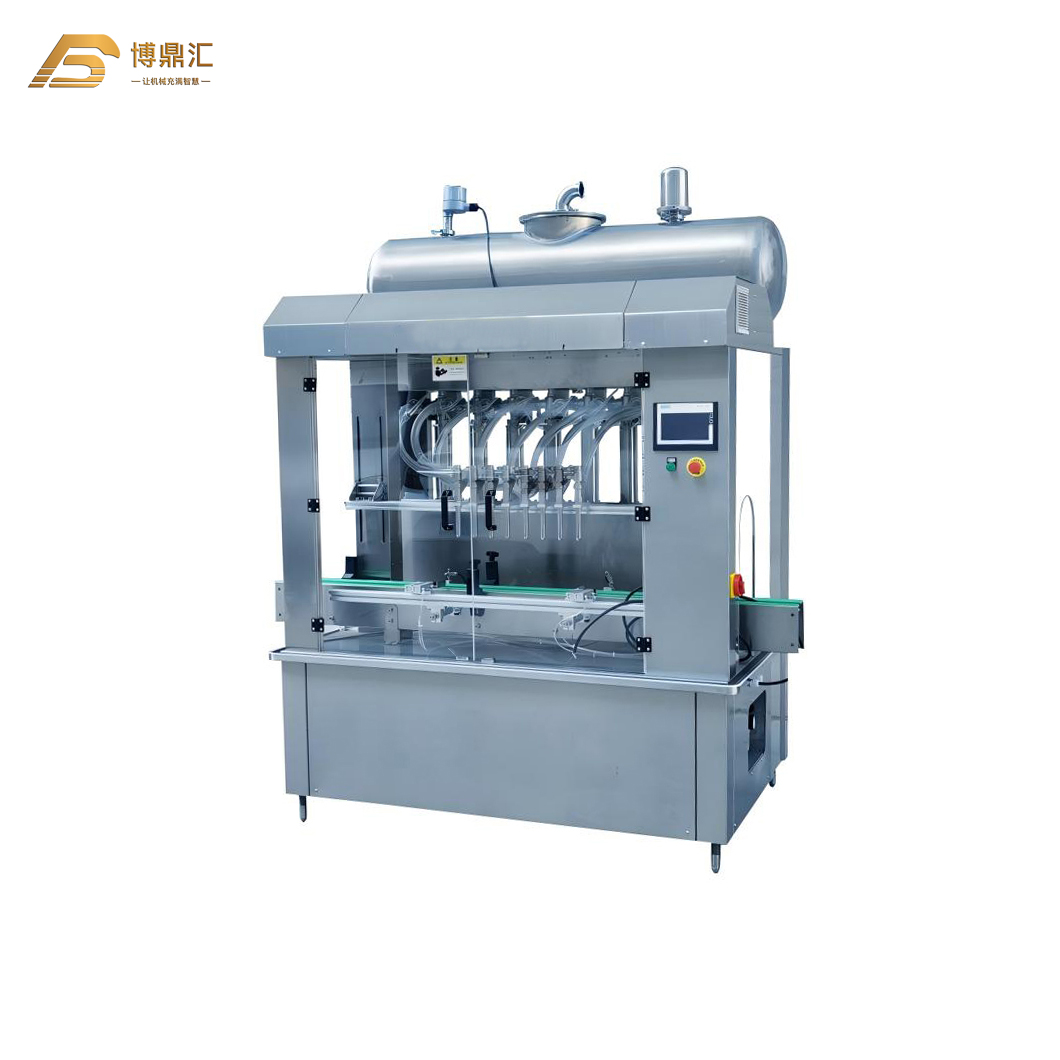
The dispensing station serves as the operational core of the manufacturing floor. Selecting a highly accurate liquid filling machine ensures volumetric precision, minimizes costly product giveaway, and maintains strict hygiene standards.
For facilities handling a diverse portfolio of fluid viscosities, servo-driven piston pump fillers offer an unmatched degree of versatility. In this setup, a mechanical piston draws a specific volume of liquid into a cylinder before forcefully pushing it into the waiting container. When driven by a servo motor rather than a traditional pneumatic cylinder, the operator gains precise digital control over the stroke length and speed. This capability allows for multi-stage profiling. The machine can start filling fast and slow down at the bottle neck to eliminate splashing. This technology is highly recommended for dense cosmetics, heavy industrial pastes, or when configuring a high-output detergent packing machine.
Gravity fillers operate on a beautifully simple principle. A time-based valve opens, allowing fluid from an overhead tank to cascade into the bottle. These machines are highly efficient for water-thin, non-foaming liquids where pinpoint volumetric accuracy takes a backseat to sheer speed. Overflow fillers, alternatively, are designed to fill containers to a specific visual cosmetic level. This becomes particularly important for products packaged in clear glass, where internal volume variations make perfectly measured liquids look uneven on a retail shelf. The liquid fills to the target height, and any excess is smoothly drawn back into the holding tank via a return manifold.
Environments requiring strict sterility—such as pharmaceutical cleanrooms or high-end biotech labs—utilize peristaltic fillers. Here, the liquid only touches the inside of flexible surgical tubing. Rotating rollers compress the tubing to move the fluid, completely eliminating cross-contamination risks. Net weigh fillers measure the exact mass of the dispensed fluid using highly calibrated load cells under each bottle. This technology is typically reserved for high-value bulk liquids sold strictly by weight.
Once the product is precisely dispensed, immediate sealing is non-negotiable to prevent contamination and spillage. The integration of a robust capping machine must be synchronized flawlessly with the upstream filler to maintain a continuous, harmonious flow across the floor.
The physical layout of your facility heavily dictates the capping architecture. Inline capping systems utilize a straight conveyor where bottles pass through a series of tightening discs or under a descending capping head. These systems are highly adaptable and accommodate a wide range of bottle heights with simple hand-crank adjustments. Monoblock systems, however, consolidate the filling and capping stations onto a single, compact chassis. Utilizing a rotary star-wheel to move bottles between stations, this configuration significantly reduces the required floor space. It also provides superior stability for small, lightweight, or top-heavy vials that might easily tip on a standard linear track.
A resilient production line must account for the specific geometry and application mechanics of the closure. Continuous thread screw caps require consistent rotational torque. Advanced cappers use magnetic clutches or servo motors to apply exact torque, preventing thread damage from over-tightening or leaks from under-tightening. Snap caps require vertical downward pressure via overhead press belts. Spray pumps with delicate dip tubes present a unique challenge, often requiring specialized mechanical plunging mechanisms to guide the curved tube into the bottle neck. High-speed lines rely on vibratory bowl feeders or centrifugal elevators to orient bulk caps correctly, delivering them down a chute to the tightening head without jamming.
Labeling is the final primary step in the individual container packaging process. Your chosen labeling machine must apply the substrate accurately—without wrinkles, bubbles, or skewing. This directly impacts the consumer's perception of brand quality on the retail shelf.
The geometry of the container dictates the application method. For standard cylindrical bottles, a wrap-around labeler is employed. The bottle is stabilized on the conveyor, and the label web is dispensed at the exact speed of the moving target. A motorized wrap belt then spins the bottle against a stationary backing pad, smoothing the label completely around the surface. For flat, oval, or rectangular containers, a front-and-back system is required. Because flat bottles cannot be spun, they are held perfectly rigid by overhead alignment belts while dual dispensing heads wipe the labels onto opposite surfaces simultaneously.
Certain products demand specialized applications, such as top-labeling for jar lids or tamper-evident neck banding. Modern labeling equipment relies heavily on advanced optical sensors. Clear labels—popular in cosmetics for a seamless aesthetic—require capacitive or ultrasonic sensors because standard photoelectric sensors look right through a transparent web. Integrated stepper or servo motors ensure the label web accelerates and decelerates in perfect harmony with the conveyor speed, maintaining tight placement tolerances.
The completion of the primary packaging phase transitions immediately into secondary packaging. End-of-line automation protects the primary containers for distribution, transforming individual units into retail-ready products while drastically reducing manual labor requirements.
Cartoning machines serve as the bridge to the shipping department. High-performance cartoners utilize rotary vacuum systems to pull flat cardboard blanks from a high-capacity magazine, erecting them precisely on the conveyor track. Depending on regulatory requirements, these machines can be equipped with secondary insertion modules that automatically fold and insert informational leaflets alongside the bottle. Once the product is secured, the machine applies the final seal, utilizing either standard tuck-in flaps or hot-melt glue systems for tamper-evident security.
The final stage involves grouping the individual cartons and preparing them for distribution. Case packing machines automatically collate a predetermined matrix of cartons and load them into larger corrugated shipping boxes. For high-volume facilities, robotic pick-and-place arms offer unparalleled precision. They gently lift grouped cartons to mitigate structural damage. Automated palletizers then stack the sealed cases onto wooden or plastic pallets according to pre-programmed load patterns, wrapping them tightly in stretch film to ensure absolute stability during transit.
The mechanical glue that holds an automated process together is the material handling system. Even the most advanced filling and capping equipment will fail if poor container management leads to constant jams and tip-overs.
Before containers even reach the dispensing station, they must be properly oriented and uniformly spaced. For lower-speed operations, rotary unscrambling tables suffice. Operators dump bulk empty bottles onto a rotating stainless steel disc, which uses centrifugal force to align them into a single-file line. High-speed environments demand fully automatic bottle unscramblers. Through a series of mechanical hooks and air jets, randomly oriented plastic bottles are stood upright and fed onto the conveyor belt at precise intervals, ensuring the bottle packaging line operates without manual interruption.
Conveyors must be engineered for the specific environmental conditions of your facility. Corrosive liquids require chemical-resistant acetal chain belts, whereas standard cosmetics can utilize modular plastic belting. A critical design element is the inclusion of accumulation zones. Picture a high-speed line. If the labeler experiences a temporary fault or requires a roll change, a bi-directional accumulation table acts as a mechanical buffer. It automatically absorbs the continuous flow of capped bottles, preventing the upstream machines from shutting down and protecting the mechanical integrity of the entire production flow.
Industrial manufacturing is rapidly shifting toward Industry 4.0 standards. Market trends highlight a growing reliance on the Industrial Internet of Things for predictive maintenance. By integrating smart sensors, modern lines can predict a motor failure before it happens, drastically reducing unplanned downtime. Future-proofing your investment means choosing machinery equipped with advanced digital architecture.
The central nervous system of modern packaging machinery is the Programmable Logic Controller. A centralized Human-Machine Interface touchscreen allows operators to monitor the entire layout from a single location. Through this panel, operators can adjust fill volumes, monitor torque parameters, and track real-time production metrics. Advanced controllers feature Ethernet communication protocols, allowing machines to share data seamlessly. If a sensor detects a low fluid level in the main holding tank, the system automatically signals the conveyor to pause, preventing underfilled bottles from ever entering the supply chain.
Consumer preferences change rapidly, and contract packagers frequently need to run multiple bottle sizes and product formulations on the same physical line. Traditional machinery required hours of manual wrenching to switch from a small vial to a large jug. Modern smart technology utilizes tool-less changeover mechanisms. Operators simply select a pre-saved recipe on the touchscreen, watching as servo motors automatically glide the guide rails, fill nozzles, and labeling belts into their exact positions. This drastic reduction in changeover time is critical for high-mix, low-volume manufacturers.
Transitioning to a fully automated system represents a significant capital expenditure. However, evaluating the financial viability requires looking far beyond the initial purchase price. Decision-makers must analyze the Total Cost of Ownership and calculate the Return on Investment based on daily operational efficiencies.
The upfront cost is dictated by several primary factors. A line designed to output 40 bottles per minute utilizing pneumatic cylinders will cost substantially less than a fully servo-driven line engineered for 150 bottles per minute. Material construction also plays a major role. Standard 304 stainless steel is cost-effective, but highly acidic products strictly require 316L or titanium wetted parts. Additionally, integrating high-speed camera inspection systems adds to the initial expense but drastically reduces the rate of defective products reaching consumers.
Automated lines deliver returns through three primary channels: massive labor reduction, waste elimination, and exponentially increased market capacity. By upgrading from a semi-automatic process to a fully integrated line, facilities often reduce their shift operators from six down to two. Furthermore, dropping volume variance from a high margin of error down to a fraction of a percent translates to tens of thousands of dollars saved annually in product giveaway. By analyzing these metrics, most manufacturing facilities discover that a well-engineered layout pays for itself within 12 to 24 months.
Designing a complete liquid filling line requires meticulous planning and a holistic view of your facility operations. Every single step—from the initial unscrambling table to the final corrugated carton—matters deeply to your bottom line. The right combination of dispensing, sealing, and labeling equipment will fundamentally transform your production efficiency. When properly matched, these machines eliminate costly daily bottlenecks entirely. We encourage you to contact packaging equipment experts to get a custom layout tailored to your specific product line. Start optimizing your facility output and securing your revenue today.
For highly viscous products, servo-driven piston pump fillers are widely considered the industry standard. Unlike gravity fillers, which rely on the natural flow of water-thin liquids, piston pumps use mechanical force to draw a precise volume of thick liquid into a cylinder and push it into the container. The integration of servo motors allows for immense control over the speed and pressure of the fill cycle, easily handling thick pastes and heavy detergents without clogging the fluid path.
A monoblock system is a highly specialized piece of packaging equipment that combines multiple packaging functions—typically filling, plug insertion, and capping—onto a single, unified mainframe. Instead of moving bottles down a long linear conveyor belt, a monoblock utilizes a central rotary star-wheel. They are highly space-efficient and provide exceptional stability for small, lightweight, or irregularly shaped containers that would otherwise tip over on a standard conveyor system.
Yes, a single capping machine can handle multiple cap variations, provided it is designed with modularity in mind. Spindle capping machines use sets of spinning rubber discs to tighten continuous-thread screw caps and can accommodate various diameters with simple adjustments. However, vastly different closure types—such as crimp-on perfume atomizers versus press-on friction caps—require interchangeable capping chucks or a machine equipped with multiple dedicated sealing stations.
The spatial footprint varies drastically based on required throughput and the level of automation. A compact, low-speed monoblock system might require as little as 10 to 15 square feet. Conversely, a high-speed inline system featuring automatic unscramblers, multi-head piston fillers, inline cappers, labelers, accumulation tables, and automatic cartoners can easily demand 50 to 150 feet of linear floor space. To accommodate constraints, engineers frequently design U-shaped or L-shaped conveyor layouts.
Labeling accuracy is heavily dependent on container stabilization. High-quality labeling machines employ synchronized top-hold belts that apply downward pressure, pinning the bottle securely against the conveyor to prevent micro-rotations. For round containers, three-point wrap-around belt systems spin the bottle seamlessly against the label web. Advanced optical sensors and stepper motors ensure the web advances at the exact microsecond required, guaranteeing perfectly straight application.
Procuring a complete, integrated line from a single Original Equipment Manufacturer provides significant operational advantages. The equipment is designed to communicate natively. The programming handshakes seamlessly, ensuring the filler knows exactly when the labeler has paused. Physical transitions like conveyor heights and guide rails are factory-matched. Furthermore, it provides a single point of accountability for technical support and spare parts, drastically simplifying long-term maintenance.